Delivery, oversight and reporting
Oversight with names attached.
Every file on request.
Five working days.
The whole file in seconds.
AMLR names who answers for compliance and gives five working days to hand over CDD evidence. First AML logs every decision against a named person, links every matter to one client profile and exports each case with a click.
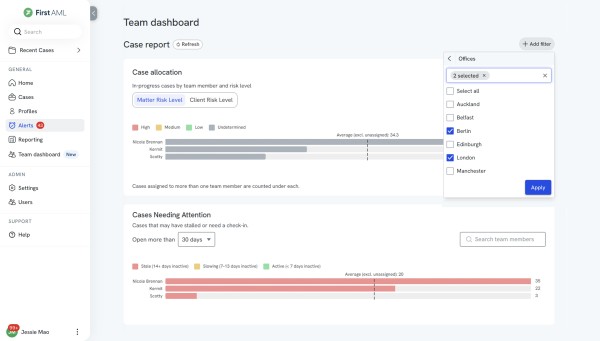
Gives management oversight of every office, practice area and jurisdiction
AMLR makes a member of management answerable for AML compliance. Dashboards show open cases, case allocation and risk overrides by office and every case shows the rule that required each check, so management sees the policy applied, not just written.
Fits each office's model, with only the access each role needs.
Each office runs AML its own way, whether centrally, through matter teams or both, and its roles and sign-off are set to match. Where matter teams run cases, approval rules send the higher-risk ones to compliance.
Gives a relying office the evidence on day one, not day five.
Offices work from one client profile, so a relying office or role (if allowed) has access to:
- identity, ownership and verification results, with every document
- screening hits and how each was resolved
- the risk assessment as it stood at the time
- every approval and override, with who made it and when
Answer an FIU request from one record.
First AML's single profile view allows firms to conduct one search across the group for a client, owner or director with the checks, documents, associated entities and decisions behind each profile and associated case.
Senior management approval
AMLR requires senior management approval to take on or keep a PEP, and for EDD involving high-risk third countries. First AML's approval rules send those cases to the approvers the firm names.
Staff conflicts
AMLR keeps staff off the compliance work of clients they're close to. First AML's activity log shows everyone who worked on a client's cases, so a declared conflict can be checked against the record.
Independent audit
AMLR expects an independent audit function to test the firm's AML policies and controls, where its size and work justify one. Auditors get read-only access to closed cases, each showing the rule that required every check and who signed it off.
Frequently asked questions
How does First AML give the compliance manager oversight when matter teams do the CDD?
Rules set what every case must include, and approval rules send the higher-risk ones to compliance. Dashboards show open cases, overrides and allocation by office, so oversight comes from exceptions, not from rechecking every file.
Who is accountable when First AML's AI screening agent makes a call?
The firm, as under AMLR it always is. The agent's calls are logged under its own name, separate from people's decisions, and every case is signed off by a named person under the office's approval rules.
How does First AML show a supervisor which rules applied to a decision made years earlier?
Each case records the rule that required each check, the risk assessment as it stood at the time and who approved it. Risk assessment forms keep their version history, so a 2027 file is read against the 2027 questions, not today's.
Can one compliance officer cover several offices in First AML?
Yes, where AMLR allows it within a group. Their role spans the offices they cover, and each office's decisions stay logged to that office.
Can First AML's data feed the firm's own risk reporting?
Yes. Case data is available through First AML's API for the firm's own reporting, and the regulatory reporting tab is built to AMLA's technical standards.
What does First AML hold when an FIU asks for information, and what comes from elsewhere?
First AML holds the CDD record: identity, ownership, screening, risk assessments and approvals, linked across offices on one profile. Transaction records come from the firm's accounts or practice management system.